

Later that day, General
Roger Ramey held a press conference at Eighth Air Force headquarters in
Fort Worth. He announced that what had crashed near Corona was a weather
balloon, not a flying saucer. He tried to convince the public by showing
the press the remains of a damaged weather balloon, which he claimed was
the actual wreckage.
This story convinced the public, and the story
died. At some time, a large number of soldiers were sent to the crash site,
whose job was to limit access to it. A search took place, well beyond the
limits of the field. In the next couple of days, the main body of the flying
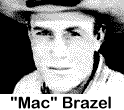
saucer was found, and then the bodies of several small humanoids. "Mac"
Brazel was taken into Military Custody for about a week. When he was let
out, he withdrew his story.
| Loretta Proctor | Mac had this piece
of material that he had picked up. He wanted to show it to us and wanted
us to go down and see the rest of the debris or whatever, but
we didn't on account of the transportation and everything wasn't too good.
He didn't get anybody to come out who was interested in it.
The piece he brought looked like a kind of tan, light brown plastic. It was very lightweight, like balsa wood. It wasn't a large piece, maybe about four inches long, maybe just a little larger than a pencil. We cut on it with a knife and would hold a match on it, and it wouldn't burn. We knew it wasn't wood. It was smooth like plastic, it didn't have a real sharp corners, kind of like a dowel stick. Kind of dark tan. It didn't have any grain, just smooth. I hadn't seen anything like it. (Loretta then suggested that Mac Brazel had been bribed to keep quiet). I think that within that year, he had moved off the ranch and moved to Alamagordo or to Tularosa and he put in a locker there. That was before people had home freezers, and it was a large refrigerated building. You would buy beef and cut it up and put it in those lockers and you had a key to it and you could get your beef out when you wanted it. I think it would have been pretty expensive, and we kind of wondered how he could put it in with rancher's wages. On the American television program "Unsolved Mysteries", Loretta Proctor said: Floyd (Loretta's husband) and a neighbour was in Roswell and saw Mac surrounded by some of the Air Force people. And they walked right by them and Mac wouldn't speak to them. They thought it was kind of funny, I guess, really wondered what he'd got into. And Mac, he wouldn't talk about it after he come back home. But he did say if he ever found something else he wouldn't report it. |
| Marian Strickland | (Marian Strickland was "Mac" Brazel's neighbour.
She said the following in an interview in 1990)
Mac made it plain he was not supposed to tell that there was any excitement about the material he found on the ranch. He was a man who had integrity. He definitely felt insulted and mis-used, and disrespected. He was worse than annoyed. He was definitely under some stress, and felt that he had been kicked around. He was threatened that if he opened his mouth, he might get thrown in the back side of the jail. He gave that impression, definitely. |
| Bessie Brazel Schreiber | (Bessie is Mac's Daughter. Here's how she described
the wreckage from the crash)
The material looked like a sort of aluminum-like foil. Some of the pieces had a sort of tape stuck to them. Even though the stuff looked like tape, it could not be peeled off or removed at all. Some of these pieces had something like numbers and lettering on them, but there were no words we were able to make out. The figures were written out like you would write numbers in columns, but they didn't look like the numbers we use at all. I also noticed a piece of something made out of the same metal-like foil that looked like a pipe sleeve. About four inches across and equally long, with a flange on one end. And what appeared to be pieces of heavily waxed paper. |
| William Brazel Jr | (William Brazel Jr is Mac Brazel's son. Here's
his description of the wreckage).
One of the pieces looked like something on the order of tinfoil, except that it wouldn't tear. You could wrinkle it and lay it back down and it immediately resumed its original shape - quite pliable, but you couldn't crease or bend it like ordinary metal. Almost like a plastic, but definitely metallic. Dad once said that the Army had once told him it was not anything made by us. There was also some threadlike material. It looked like silk, but was not silk, a very strong material without strands or fibers like silk would have. This was more like a wire, all one piece or substance. There were some wooden-like particles like balsa wood in weight, but a bit darker in color and much harder - It was pliable but wouldn't break. Weighed nothing, but you couldn't scratch it with your fingernail. All I had was a few small bits. There was no writing or markings on the pieces I had but Dad did say one time that there were what he called "figures" on some of the pieces he found. He often referred to the petroglyphs the ancient Indians drew on the rocks around here as "figures", too, and I think that's what he meant to compare them with. He also said: My dad found this thing and he told me a little bit about it, not much, because the Air Force asked him to take an oath that he wouldn't tell anybody in detail about it. He went to his grave and he never told anybody. He was an old-time Western cowboy, and they didn't do a lot of talking. My brother and I had just went through World War II (him in the Army and me in the Navy) and needless to say, my dad was proud. Like he told me, "When you guys went in the service, you took an oath, and I took an oath not to tell." The only thing he said was, "Well, there's a big bunch of stuff, and there's some tinfoil, some wood, and on some of that wood there was Japanese or Chinese figures." I rode out to the crash site on the average of once a week, and I was riding through that area, I was looking. That's why I found those little pieces. Not over a dozen pieces. I'd say maybe eight different pieces. But there was only three different items involved: something on the order of balsa wood, something on the order of heavy-gauge monofilament fishing line, and a little piece of - it wasn't tinfoil, it wasn't lead foil - a piece about the size of my finger. Some of it was like balsa wood: real light and kind of neutral color, more of a tan. To the best of my memory, there wasn't any grain in it. Couldn't break it, it'd flex a little. I couldn't whittle it with my pocket knife. The "string", I couldn't break it. The only reason I noticed the tinfoil (I'm gonna call it tinfoil), I picked this stuff up and put it in my chaps pocket. Might be two or three days or a week before I took it out and put it in a cigar box. I happened to notice when I put that piece of foil in that box, and the damn thing just started unfolding and just flattened out. Then I got to playing with it. I'd fold it, crease it, lay it down and it'd unfold. It's kinda weird. I couldn't tear it. The color was in between tinfoil and lead foil, about the thickness of lead foil. I was in Corona, in the bar, the pool hall. Sort of the meeting place, domino parlor... That's where everybody got together. Everybody was asking, they'd seen the papers (this was about a month after the crash) and I said, "Oh, I picked up a few little bits and pieces and fragments." So, what are they? "I dunno." Then, lo and behold, here comes the military out to the ranch, a day or two later. I'm almost positive that the officer in charge, his name was Armstrong, a real nice guy. He had a black sergeant with him that was real nice. I think there was two other enlisted men. They said, "We understand your father found this weather balloon." I said,"Well yeah." "And we understand you found some bits and pieces." I said, "Yeah, I've got a cigar box that's got a few of them in there, down at the saddle shed." And this (I think he was a captain), and he said, "Well, we would like to take it with us." I said, "Well..." And he smiled and he said, "Your father turned the rest of it over to us, and you know he's under an oath not to tell. Well," he said, "we came after those bits and pieces." And I kind of smiled and said, "OK, you can have the stuff, I have no use for it at all." He said, "Well, have you examined it?" And both civilian and military assignments. On July 9 or 10, 1947, Dennis got several phone calls from the Roswell AAF mortuary officer, who was more of an administrator than a mortuary technician. The officer wanted to know about hermetically sealed caskets ("What was the smallest one they could get?"), and about chemical solutions. Dennis was interviewed in August 1989 by Stanton Friedman. This is what was so interesting. See, this is why I feel like there was really something involved in this, because they didn't want to do anything that was going to make an imbalance. They kept saying, "OK, what's this going to do to the blood system, what's this going to do to the tissue?" Then when they informed me that these bodies had laid out in the middle of July, in the middle of the prairie, I mean that body's going to be as dark as your navy blue blazer there, and it's going to be in bad shape. I was the one who suggested dry ice. I'd done that a time or two. I talked to them four or five times in the afternoon. They would keep calling back and asking me different questions involving the body. What they were really after was how to move those bodies. They didn't give me any indication they even had the bodies, or where they were. But they kept talking about these bodies, and I said, "What do the bodies look like?" And they said, "I don't know, but I'll tell you one thing: This happened some time ago." The only thing that was mentioned was that they were exposed to the elements for several days. I understand these bodies weren't in the same location as where they found some of the others. They said the bodies weren't in the vehicle itself; the bodies were separated by two or three miles from it. They talked about three different bodies: two of them mangled, one that was in pretty good shape. That evening, Dennis took a GI accident victim to the base infirmary, which was in the same building as the hospital and the mortuary. He walked the injured GI inside, then drove around to the back to see a young Army Air Forces nurse he had got to know recently. There were two MPs standing right there, and I got out and started to go in. I wouldn't have gotten as far as I did if I hadn't parked in the emergency area. They probably thought I was coming after somebody. The doors were open to the military ambulances and that's where some wreckage was, and there was an MP on each side. I saw all the wreckage. I don't know what it was, but I knew there was something going on, and that's when I first got an inclination that something was happening. What was so curious about it, was that in two of those ambulances was a deal that looked like the bottom half of a canoe. It didn't look like aluminum. You know what stainless steel looks like when you put heat on it? How it'll turn kinda purplish, with kind of a blue hue to it? Dennis later said that he saw a row of unrecognizable symbols several inches high on the metal. I just glanced in and kept going. When I got inside, I noticed there was quite a bit of activity. When I went back into the lounge, there were "big birds" high-ranking officers everywhere. They were really shook up. So I went down the hall where I usually go, and I got down the hall just a little way and an MP met me right there. He wanted to know who the hell I was and where I was from, and what business did I have there? I explained who I was. Evidently he was under the impression that they called me to come out. Anyway, I got past that and I went on in and then this is where I met the nurse. She was involved in this thing, she was on duty. She told me, "How in the hell did you get in here?" I said, "I just walked in." She said, "My God, you are going to get killed." And I said, "They didn't stop me." I was going to the Coke machine to get us a Coke, and this big red-headed colonel said, "What's that son of a bitch doing here?" He hollered at the MPs and that's when it hit the fan. These two MPs grabbed me by the arms and carried me clear outside. They carried me to the ambulance. I didn't walk, they carried me. And they told me to get my ass out of there. They followed him back to the funeral home. About two or three hours later, they phoned and told me, "You open your mouth and you'll be so far back in the jug they'll have to shoot pinto beans into you with a bean shooter." I just laughed and said, "Go to hell." (Dennis spoke with the nurse again the following day). She said there were three little bodies. Two of them were just mangled beyond everything, but there was one of them that was really in pretty good condition. And she said, "Let me show you the difference between our anatomy and theirs. Really, what they looked like was ancient Chinese: small, fragile, no hair." She said their noses didn't protrude, the eyes were set pretty deep, and the ears were just little indentations. She said the anatomy of the arms was different, the upper arm was longer than the lower. They didn't have thumbs, they had four different, she called them "tentacles", I think. Didn't have any fingernails. She then described how they had little things like suction cups on their fingertips. I asked her were these men or women? Were their sex organs the same as ours? She said, "No, some were missing." The first thing that decomposes on a body would be the brain, next the sex organs, especially in women. But she thought there had probably been something, some animals. Some of these bodies were badly mutilated. She said they got the bodies out of those containers (The ones he had seen in the backs of the ambulances whilst entering the hospital). See, they weren't at the crash site, they were about a mile or two from the crash site. She said they looked like they had their own little cabins. She said the lower portion, the abdomen and legs, was crushed, but the upper portion wasn't that bad. She told me the head was larger and it was kind of like, the eyes were different. (A few weeks later, Dennis heard from his father). "What the hell'd you get into? What kind of trouble are you in?" I said, "I'm not in any trouble." And he said, "The hell you're not. The sheriff (The elder Dennis' friend) said that the base personnel have been in and they want to know all about your background." |
